Most homeowners think foreclosure is a straight line: missed payments → lawsuit → sale. In real life, it’s a file that moves forward in court unless someone forces the lender to prove its case, follow procedure, and address legitimate disputes.
A qualified foreclosure attorney doesn’t just “show up.” They build a strategy around deadlines, service issues, documentation defects, loss-mitigation rules, and the lender’s incentives—so the case doesn’t become a quiet, uncontested march toward default and judgment.
Key idea:
There is a difference between “buying time” and creating usable time. Qualified counsel uses the calendar to (1) prevent default momentum, (2) force clarity and compliance, and (3) negotiate from a stronger position—while still preparing for court fights if necessary.
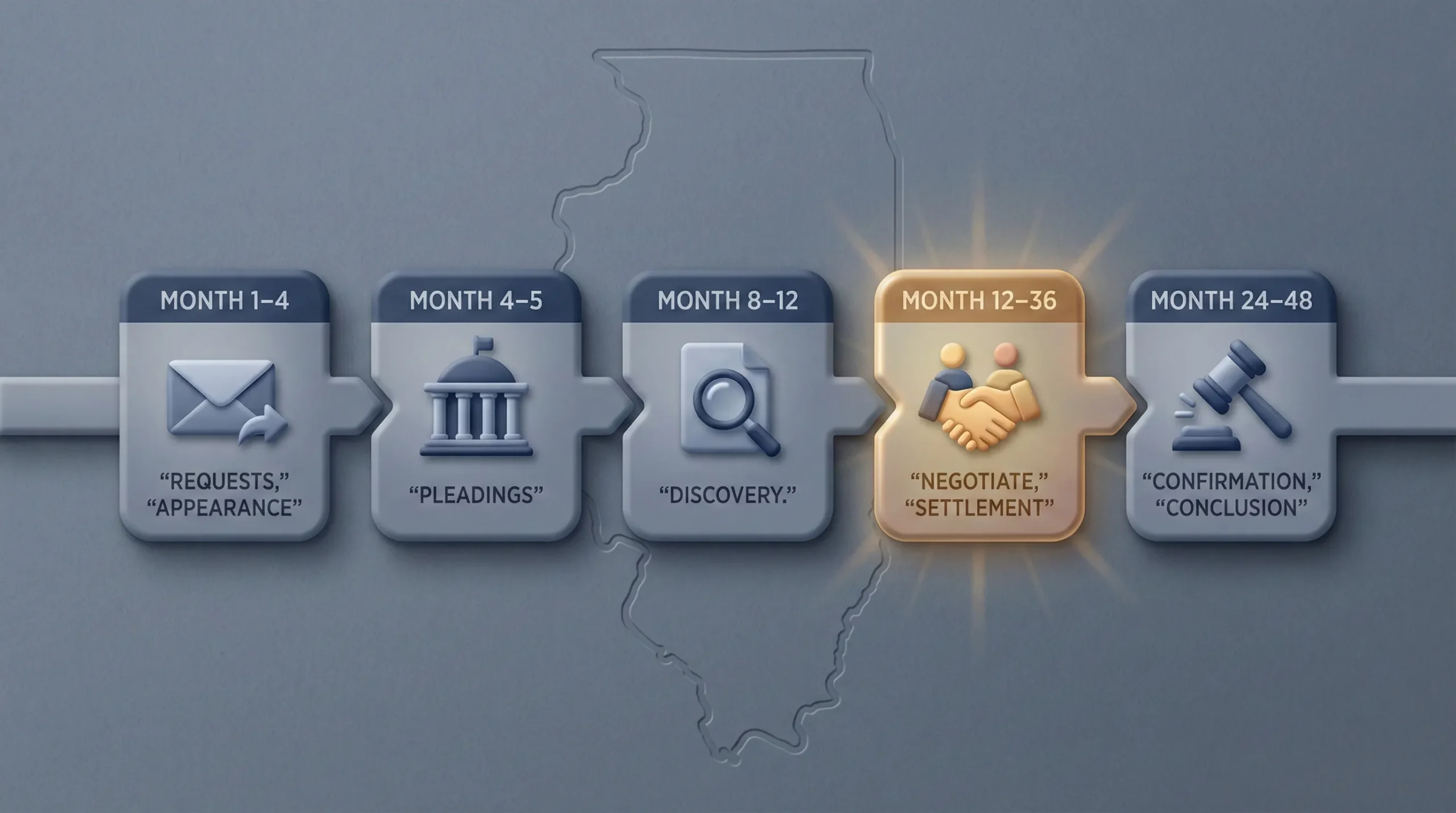
Below is a plain-English, month-by-month view of what the timeline can look like with qualified counsel. For the broader baseline timelines, see:
Free Case Analysis
If you have a case number or court date, don’t guess.
Call (312) 775-0980 or send your most recent papers so we can map your timeline and next move.
Month 1–4: Pre-Foreclosure — Attorney Challenges the Lender Directly
When you retain counsel early enough, the first phase is often about forcing information and creating leverage before the case becomes a courtroom sprint.
Qualified counsel may send targeted written requests and dispute notices (including federal servicing-based requests when applicable) to surface issues like misapplied payments, incorrect default amounts, missing notices, and servicing errors. The goal is not paperwork for paperwork’s sake—the goal is to build a record and put the lender on notice that this file will be examined.
At the same time, if your goal is to keep the property, this is where your “save the home” work begins: gathering financials, building a clean package, and starting loss mitigation through the right channels.
What You Should Collect Immediately (So Your Lawyer Can Move Faster)
If you want speed and clarity, start building a single folder with:
- Income proof: pay stubs, benefits statements, profit/loss if self-employed
- Bank statements (recent months)
- Tax returns (most recent 1–2 years if available)
- Mortgage statements and any escrow/tax/insurance letters
- Loss mitigation history: uploads, denials, emails, names/dates
This documentation does two things: it supports negotiation, and it helps your attorney spot inconsistencies in the lender’s numbers and allegations.
Why this phase matters:
Federal servicing rules can restrict certain foreclosure steps depending on your delinquency stage and the timing/completeness of a loss mitigation application. These protections are document-driven, so proof of submission and completeness is critical.
Even if you’re not sure you can keep the home, early organization still helps. It preserves options for a controlled exit (sale, short sale, settlement) and reduces the chance of surprise filings and rushed decisions.
Month 4–5: Foreclosure Complaint Is Filed (But Your Rights Don’t End)
Once the complaint is filed, the case becomes deadline-driven. The lender will serve the summons and complaint, and hearings are scheduled based on the court’s calendar. The most important early objective is preventing the case from sliding into default simply because the borrower is overwhelmed.
What qualified counsel typically does here:- Files an appearance and evaluates response deadlines
- Checks service issues (improper service can be a major defense point)
- Reviews whether the complaint and attachments comply with Illinois foreclosure requirements and court rules
- Starts shaping the case around your goal: keep, negotiate, reinstate, or exit
This phase is also where foreclosure defense becomes different from “general practice.” In Illinois mortgage cases, courts have specific expectations about documentation, pleadings, and proof. The earlier those issues are identified, the more options you usually preserve.
Stop Default Momentum
If a motion for default or judgment is coming, timing matters. A quick review can clarify what the bank is asking for—and what your response should be.
Month 8–12: Notice of Motion for Default (The “Preventable Disaster” Stage)
In many cases, the lender will move for default if the borrower has not responded properly. With counsel, the pattern often changes: the attorney appears, advises the court that the borrower is represented, and requests the time needed to file appropriate pleadings and defenses.
Plain-English translation:
This is where you either (1) stop the file from becoming an uncontested foreclosure, or (2) let the lender convert silence into a faster path toward judgment and sale scheduling.
Month 12–36: Rigorous Foreclosure Defense (Litigate + Negotiate)
This is the phase where qualified foreclosure defense looks like real work: targeted pleadings, motion practice, discovery, and consistent pressure on the lender’s proof and compliance.
Depending on the file, that can include:
- Motions to quash or challenge service defects
- Motions to dismiss for procedural defects or documentation failures
- Substantive defenses and affirmative defenses
- Counterclaims (when supported by facts and law)
- Discovery requests, motions to compel, and forcing clear accounting
But strong litigation is only half the solution. The other half is diplomacy: negotiating from a position of leverage. Qualified counsel knows that getting a modification, short sale, deed in lieu, or settlement is not “stacking papers.” It’s presenting your financial story in a way the lender can approve—and protecting you from bad deals and terms that prolong the problem.
Stop Dual Tracking and Use the Calendar as Leverage
“Dual tracking” is when foreclosure continues to move while loss mitigation is supposedly under review. Federal mortgage servicing rules (Regulation X) include timing-based protections that can limit certain foreclosure steps when a complete loss mitigation application is pending and timely submitted.
These rules are technical. The practical takeaway is simple: proof matters. Upload confirmations, written acknowledgments, completeness letters, and dates can change what the servicer is allowed to do next.
What a qualified attorney does differently:
They coordinate the loss-mitigation timeline with the court timeline so you’re not blindsided by a major motion or sale scheduling while the servicer claims they’re still “reviewing” your file.
When the timeline is controlled, you regain options: more realistic negotiation, stronger defenses, and fewer emergency “last week” decisions.
Month 24–48: Judges, Banks, and Late-Stage Risk (Including Deficiency)
If a case reaches late-stage litigation, you’ll see more direct court pressure to move the file along. No legitimate lawyer can promise a result—but qualified counsel can still change the pace by forcing the lender to prove what it must prove and by raising supported objections when the record is defective.
One late-stage risk that many homeowners underestimate is a deficiency judgment—a personal money judgment for the amount still owed after a sale if the property sells for less than the debt (depending on what was requested and proven). Illinois judgment rules can allow revival/enforcement within long statutory windows, which is why deficiency risk must be treated seriously.
At confirmation and late-stage hearings, lenders may need to prove key points such as:- Proper notice of sale
- Reasonable terms of sale
- No fraud or material irregularities in the sale process
- Compliance with applicable loss-mitigation / program rules where properly raised
This is also where planning becomes essential. If keeping the home is no longer realistic, a controlled exit strategy (sale, short sale, settlement terms) can still protect you from worse outcomes—especially if handled before the timeline collapses into emergency mode.
What You Can Do Today (A 72-Hour Foreclosure Defense Plan)
If you want to move fast, don’t start by memorizing foreclosure law. Start by organizing your file and clarifying your goal. The next 72 hours should be about reducing uncertainty and preventing avoidable mistakes.
72-hour checklist:- Find your case number and next court date (if filed).
- Create one folder with all court papers and another with servicer communications.
- Write your goal in one sentence: keep, negotiate, reinstate, or exit.
- Gather the core financial documents (income, statements, taxes).
- Document every submission and every call with dates and names.
A qualified foreclosure attorney can then do what most homeowners can’t do alone: translate the docket into a strategy, file the right pleadings at the right time, and negotiate with the lender from a position backed by procedure and evidence.
If you’re ready for a case review, start with your most recent filings and any loss-mitigation correspondence. The faster we can understand the file, the faster we can protect your options.
Need a Real Plan?
Keeping the home, negotiating a workout, or exiting cleanly all require different timelines. We’ll help you choose the path that matches your goals and your file.
Frequently Asked Questions
Educational answers about how qualified counsel can change the foreclosure timeline in Illinois.
Written By: