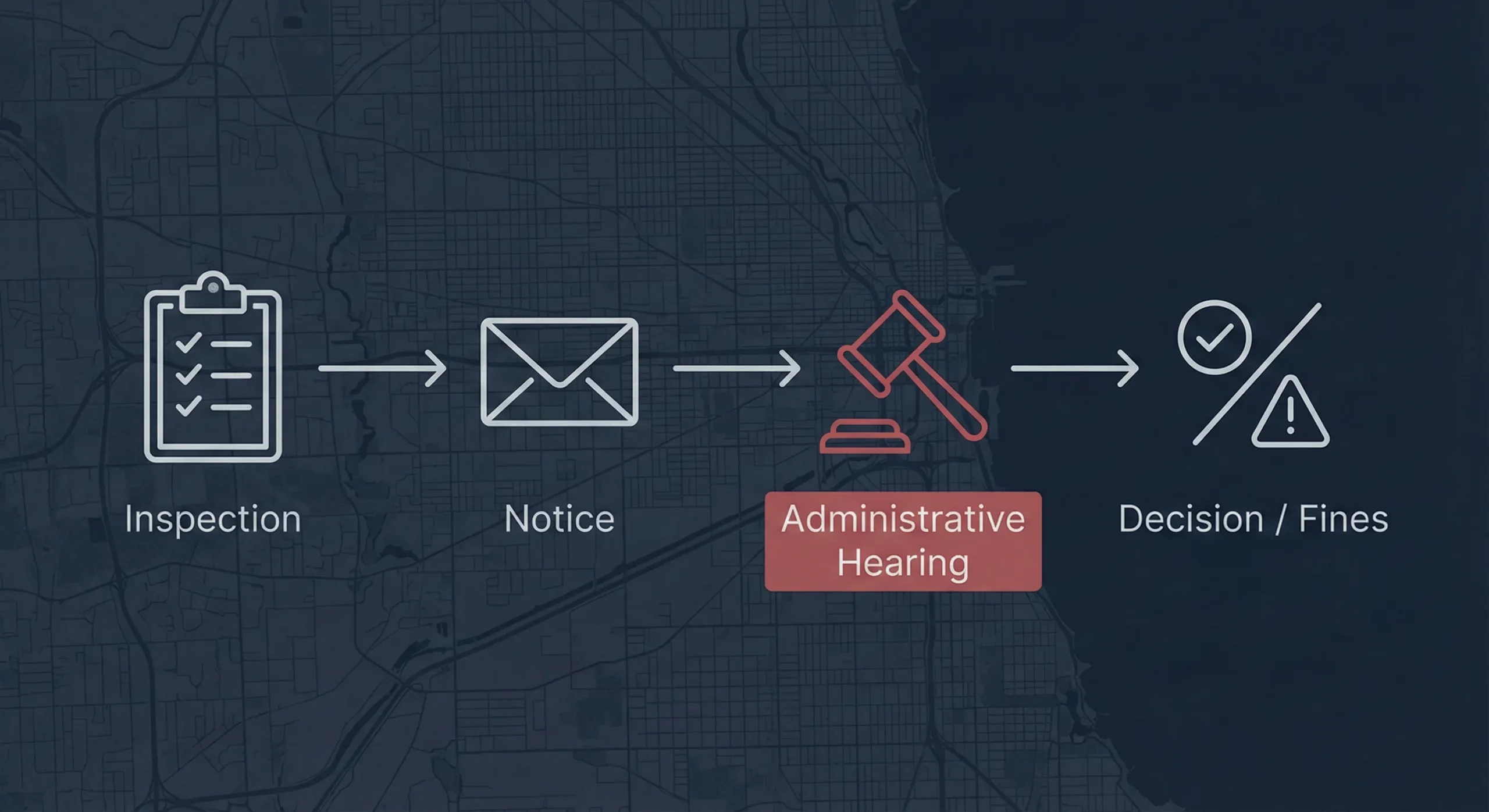
Chicago requires building owners to follow safety and maintenance rules to protect residents and the public. When the City believes a property violates the Municipal Code, it can issue a notice and pursue fines through an administrative hearing process.
Sometimes the violation is real and urgent. Sometimes the facts are incomplete, the issue was already corrected, or the notice doesn’t match what was actually observed. The key is responding in a way the system will accept: timely, organized, and evidence-based.
Important: EV Häs, LLC Attorney at Law notes that a recent ruling may require certain property owners and corporations to obtain legal representation for administrative hearings. If you received a notice, confirm early whether representation rules apply to you so you don’t show up unprepared.
Below, we’ll break down (1) what the City is trying to prove, (2) the defenses Chicago explicitly allows for building code violations, and (3) the practical steps that can reduce penalties—or strengthen a full defense.
Got a violation notice?
Send it to us. We’ll spot the strongest defenses and what proof you need next.
The Big Picture: How Chicago Enforces Building Code Violations
Chicago’s enforcement process involves multiple departments and typically runs through an administrative hearing system that provides owners due process.
The Buildings Hearings Division handles many cases initiated by City departments (including building code matters). The City also publishes a step-by-step overview of how building code violation enforcement works, including inspection activity and what happens when a case is routed to administrative hearings or court.
What the City Usually Cares About
In most building-violation cases, the hearing officer is watching for two things:
- Did the violation exist at the relevant time?
- Did the owner take reasonable steps to correct it?
That’s why the best defenses are built around verifiable facts—photos, dates, repair invoices, access logs, and communications.
Do this immediately:- Save the notice and calendar the hearing date
- Take dated photos/video of the area cited
- Gather repair records, permits, and contractor communications
- If access is an issue, start an access log today
Even when you plan to correct the issue, documenting your actions matters. Administrative hearings reward organization—especially when the City’s file is incomplete or the property facts are being generalized.
Chicago’s Recognized Defenses to Building Code Violations
Chicago Municipal Code Section 2-14-155 lists specific defenses to building code violations adjudicated under the administrative hearing system. If your situation fits one of these, you want to frame your case around that defense and attach evidence that directly supports it.
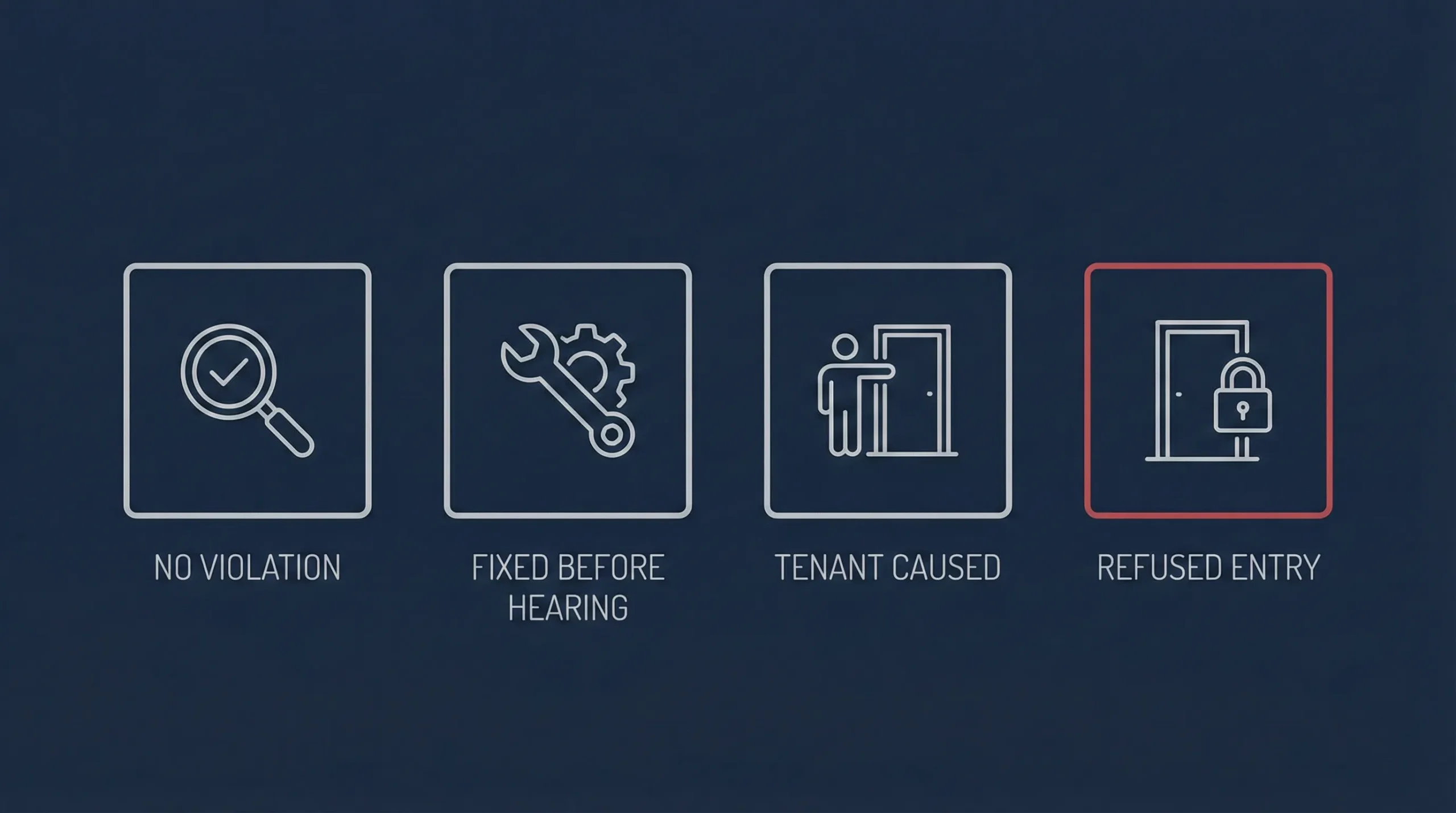
Common 2-14-155 defenses (plain English):- No violation existed: the condition cited did not exist at the time of inspection
- Fixed before the hearing: the violation was remedied by the time of the hearing (depending on the type of violation)
- Tenant/occupant caused it: the violation was caused by occupants (including certain recent evictions)
- Refused entry: a tenant/occupant refused the owner or agent entry to correct the violation
The strongest defense is usually the one you can prove quickly. If you can’t prove it, don’t lead with it. Choose the cleanest, most documentable defense and build your packet around it.
Tenant blocking repairs?
We’ll help you document access attempts and protect your position.
Defense #1: “The Violation Didn’t Exist” (or the Notice Is Factually Wrong)
If the alleged condition wasn’t present, your goal is to show that the City’s notice doesn’t match reality at the time of inspection.
Best supporting proof:- Dated photos/video from the relevant period
- Third-party records (contractor reports, inspections)
- Permit records (when relevant)
- Witness statements (when helpful and credible)
Pro tip: If you’re relying on photos, make them easy to verify—wide shot + close-up, consistent angles, and a short label list like: “Exhibit A1–A6”.
Defense #2: “It’s Already Fixed” (Remedied Before the Hearing)
Chicago law recognizes a defense when the violation has been remedied by the time of the hearing—though the applicability can depend on the nature of the violation. If you’re using this defense, the hearing is no longer about arguing the condition exists; it’s about proving the correction is real and complete.
Best supporting proof:- Paid invoices and signed scope of work
- Before-and-after photos (dated)
- Permits and final inspections (if required)
- Receipts for materials + contractor communications
Defense #3 and #4: Tenant Caused It or Tenant Refused Entry
Chicago’s code also recognizes defenses where the violation is caused by the tenant/occupant—or where the tenant/occupant refused the owner or agent entry to correct the issue.
If this is your situation, your entire strategy is documentation. You want proof that you attempted access and attempted correction in a reasonable, consistent way.
Access log checklist (simple but powerful):- Date/time of each access request
- How notice was delivered (text/email/written)
- Tenant response (or non-response)
- Contractor scheduled dates (and what happened)
- Any witness notes (property manager, contractor)
If you were refused entry, keep your communications calm and professional. Aggressive messages can undermine a defense that would otherwise be strong. The goal is to show reasonable efforts to fix the issue—and a documented barrier outside your control.
What to Do After You Receive a Notice
If you received a building code notice in Chicago, you want to do three things immediately: preserve evidence, control the timeline, and avoid accidental admissions that make your defense harder.
Immediate action steps:- Calendar every deadline (hearing date, compliance dates, reinspection)
- Photograph everything (wide + close-up)
- Start repairs if appropriate (and keep records)
- Build your evidence packet (exhibits labeled A, B, C)
- Confirm hearing format and whether counsel is required for your entity type
Don’t wing it. Administrative hearings move quickly. A clean, labeled packet can be the difference between “reduced / dismissed” and “maximum fines.”
If you’re already correcting the issue, don’t stop there—document it. In this system, undocumented repairs can be treated like they never happened.
How an Attorney Helps in a Building Code Violation Case
A good defense is not just “arguing.” It’s choosing the right legal defense, presenting it clearly, and matching it with the right proof. Counsel can help you:
- Identify the strongest Chicago-code defense for your facts
- Organize evidence so it’s easy for the hearing officer to verify
- Coordinate access issues with tenants and contractors
- Avoid procedural mistakes that cost you leverage
Best use of counsel: turning chaos into a clean record—so you’re not paying fines because your proof was disorganized.
If you’re a landlord, counsel can also help you avoid collateral problems (like retaliation claims, improper entry practices, or documentation gaps) while you’re trying to fix the underlying violation.
If you want help, start by sending the notice and any photos you already have. We’ll tell you what defense fits best and what to gather next—fast.
Need a hearing plan?
Call (312) 775-0980 for a fast, practical strategy review.
Frequently Asked Questions
Chicago building code violations, defenses, and hearings—explained in plain English. Educational only; not legal advice.
Written By: