Every year, property owners across Chicago open a tax bill and ask the same question: “Why is this so high—and what can I actually do about it?”
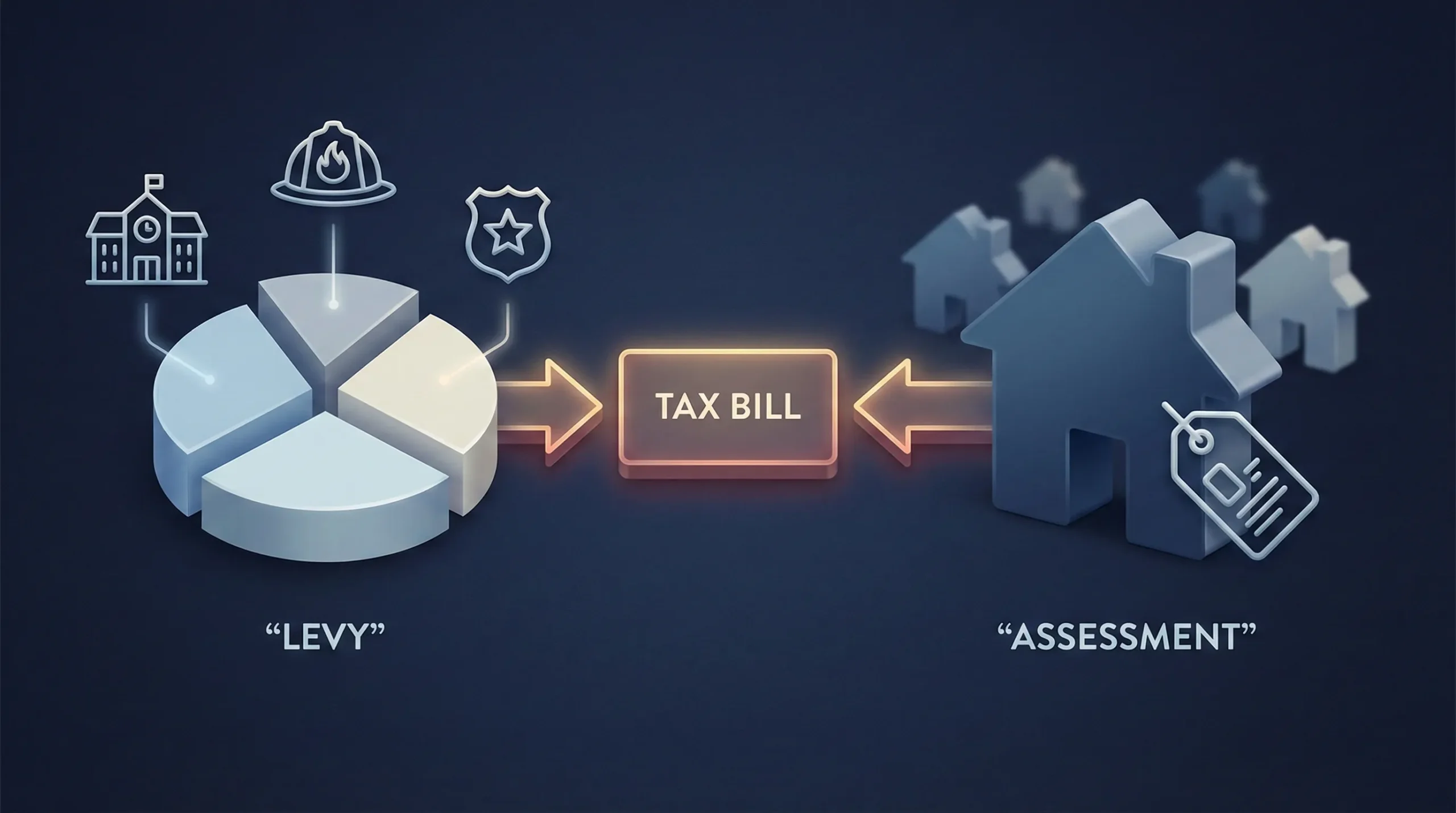
The answer is usually not one dramatic “mistake.” It’s a system doing math: local budgets become a levy, your property gets assessed, and the bill is the result of those two forces meeting in the middle.
Quick reset: A lower tax bill usually comes from changing the inputs (your assessed value / classification) or catching an error—not from arguing that taxes are “unfair.” The strongest appeals are boring: clean comps, correct square footage, accurate classification, and documented problems.
Below, we’ll walk through the process step-by-step, then show the appeal routes (Assessor, Board of Review, PTAB/Circuit Court) and the kind of documentation that tends to matter most. This is information only, not legal advice, and outcomes vary by property and evidence.
If you’re unsure where your bill is coming from, start here—you’ll understand what you’re looking at before you spend money guessing.
Want to challenge your assessment?
Upload your bill and any recent valuation notice. We’ll tell you what’s driving the number and whether an appeal is worth it.
Step One: The Tax Levy (What Your Town Needs to Run)
Think of the levy as the “target number.” Local services—schools, parks, libraries, police, fire, and more—set budgets for the year. Those budgets combine into a total amount the county must collect from property owners.
Once that total levy exists, the system determines what portion comes from each property across the tax base. Your tax bill isn’t just about your house—it’s also about what your local government is trying to fund and how large the overall tax base is in your area.
Where the Levy Shows Up on Your Bill
Most homeowners notice the rate before they notice the levy. But the rate is just the levy expressed as a percentage of taxable value across all properties.
If local budgets rise, or the taxable base shrinks, rates can climb even if your property value feels unchanged.
Plain-English translation: The levy is the total bill for local services. The “tax rate” is how your share gets calculated after everyone’s taxable values are added together.
This is why two neighbors with similar homes can experience different tax changes year-to-year—boundaries, overlapping districts, and shifting budgets all matter. The levy side is the part you don’t control, but you can still understand it so the bill stops feeling random.
Step Two: The Assessment (How Your Share Is Determined)
Assessments estimate a property’s market value using sales data and other valuation methods. The assessor’s office—not the county clerk—does this work, and it happens on a cycle. In Cook County, properties are generally reassessed every three years. :contentReference[oaicite:1]{index=1}
After an estimated market value is set, the system applies the appropriate assessment percentage and classification rules to reach an assessed value used for taxation.
Assessment is not a tax bill. It’s one input. But it’s the input you can most often challenge with evidence—especially if the value, classification, or property characteristics are wrong.
If your assessment assumes features you don’t have (finished basement, extra bathrooms, larger square footage), or ignores issues you do have (condition problems), you may be paying based on a fictional version of your property. Strong appeals start by correcting the record, then supporting the corrected value with comparable sales and clear documentation.
Short deadline? Don’t wait.
Appeal windows can close fast. If your notice is recent, get it reviewed now so you don’t miss your shot.
The Equalization Factor: The “Multiplier” That Can Change the Math
After local assessments are finalized, the Illinois Department of Revenue may apply an equalization factor (often called a “multiplier”) so assessment levels align with state guidelines. :contentReference[oaicite:2]{index=2}
This step can feel invisible because homeowners don’t receive a friendly explanation in the mail—your taxable value can change even when you didn’t “do” anything.
What to remember: An appeal is usually about your market value / assessed value and property facts. The multiplier is a separate layer meant to normalize assessments across jurisdictions—so you handle it by tightening your underlying valuation argument.
Where (and How) You Can Appeal in Illinois
If you believe the assessment is too high, Illinois gives you multiple lanes to challenge it. The most common paths include:
- Assessor’s Office complaint (file within the posted window)
- County Board of Review (separate deadline and process)
- Illinois Property Tax Appeal Board (PTAB) (typically after Board of Review)
- Circuit Court tax objection (often requires full payment and strict procedure)
:contentReference[oaicite:3]{index=3}
The correct lane depends on where you are in the cycle and what kind of evidence you have. Some cases are about incorrect property characteristics; others are about valuation. Either way, the decision-maker expects a clean, supported position—not just frustration.
What a Strong Appeal Packet Usually Includes
If you want to win time and credibility, walk in with documentation that answers the silent question:
“Why should we believe this number instead of the assessor’s number?”Common evidence includes:
- Comparable sales (recent, similar size, similar neighborhood)
- Photos showing condition issues that affect market value
- Property record corrections (square footage, rooms, features)
- Closing documents if you purchased recently (context matters)
- Contractor estimates for major defects (when relevant)
Pro tip: “My taxes are too high” is not an appeal argument. “The record is wrong” or “The market value is overstated, and here are comps”—those are appeal arguments.
If you’re missing comps or you’re not sure what counts as “similar,” don’t guess. Bad comparables can hurt you. It’s better to submit fewer, stronger comps than a pile that looks random.
How Your Tax Bill Is Calculated (The Simple Version)
At the end of the process, your bill is a combination of three elements: your property’s assessed value, the state equalization factor, and your local tax rate. :contentReference[oaicite:4]{index=4}
Each piece comes from a different place, which is why the bill can change even when you feel like “nothing changed.”
Once you understand which input moved, you can stop spinning your wheels. If the problem is your assessed value, you focus on valuation evidence. If the problem is the local rate, you focus on understanding budgets and districts (and you plan for it).
In plain math:
Total Assessed Value × Equalization Factor × Local Tax Rate = Your Tax Bill :contentReference[oaicite:5]{index=5}
That formula is why effective appeals are targeted. You’re not “fighting taxes.” You’re correcting the parts of the formula that can legally be corrected—using the kind of proof the system recognizes.
What to Do Next: A Practical Checklist
If you’re reading this with a bill in hand, your next move is not to panic-scroll forums. Your next move is to gather the documents that let you evaluate an appeal quickly and accurately.
Five things to gather today:- Your most recent tax bill
- Your assessment notice (if you received one)
- Any recent appraisal or refinance valuation
- Photos of condition issues that affect value
- A short list of nearby recent sales you believe are comparable
Once you have those, you can answer the key question: Is this a record problem, a valuation problem, or both? That determines whether an appeal is likely to help and which lane makes sense.
If deadlines are close—or you’re not sure what you’re looking at—get it reviewed. The biggest avoidable loss in tax appeals is missing the window while you’re still trying to “figure it out.”
Prefer to talk it through?
Call (312) 775-0980 and we’ll explain the process in plain English and what to gather next.
Frequently Asked Questions
Clear answers for Chicago-area homeowners who want to understand their tax bill and the appeal process.
Written By: