Most people hear the word foreclosure and assume it means one thing: “I’m going to lose my house.” In reality, an Illinois foreclosure case is a process—and your options change depending on where you are in that process.
Some homeowners need time and structure so they can submit a complete modification package. Others need a defense strategy because the paperwork is wrong, the notices were defective, or the numbers don’t add up. And sometimes the smartest move is an exit strategy that protects equity and prevents surprises.
Big picture: Federal servicing rules generally restrict a servicer from making the first legal filing for foreclosure until the loan is more than 120 days delinquent (with limited exceptions). That doesn’t mean you should wait—early action usually creates better options.
Information only. Outcomes and timelines vary by case.
Below is a practical roadmap of the most common foreclosure options we see in Illinois—especially in Cook County and the Chicago area. If you’re not sure what stage you’re in, start with the first section and work downward like a checklist.
Not Sure What Stage You’re In?
Share your most recent notice or court date. We’ll help you identify your stage and the most realistic next step for your situation.
Information only, not legal advice.
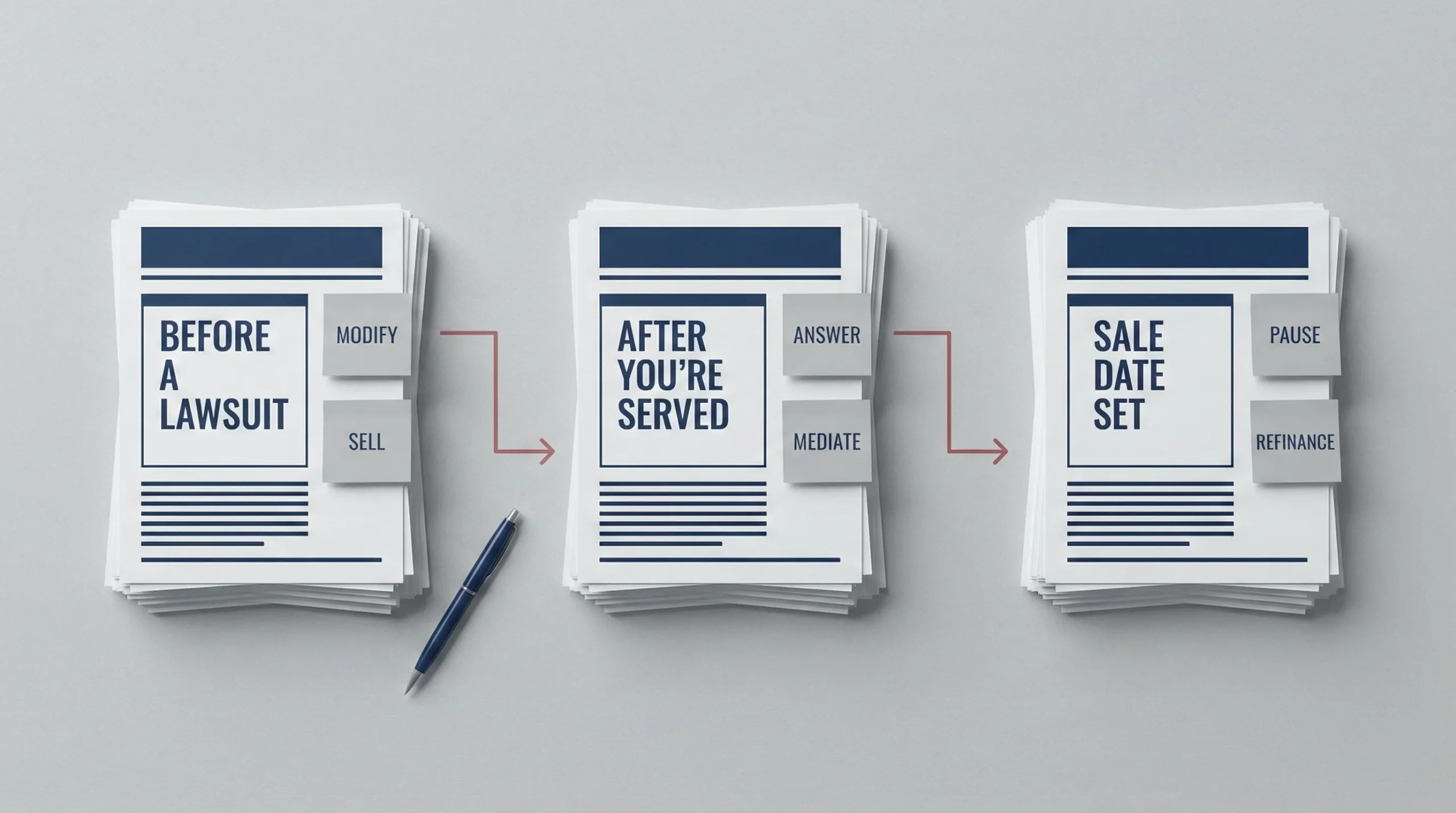
Step One: Identify Your Stage (Because Options Change Fast)
A foreclosure “option” isn’t one-size-fits-all. The same idea—like a loan modification—looks very different
before a case is filed versus
after you’ve been served, and different again when the case is heading toward judgment or sale.
As a starting point, ask:
Where am I right now?- Pre-foreclosure: You’re behind, getting letters/calls, but no summons and complaint yet.
- Active lawsuit: You’ve been served (or found the case online). There is a case number and court dates.
- Judgment / sale phase: Motions are pending, a judgment is entered, or a sheriff’s sale date is being discussed.
A Simple Rule: Match the Tool to the Timeline
When you’re early, your strongest tools are often administrative: complete financials, clean hardship narrative, consistent follow-up, and proof of income. When you’re later, your strongest tools are often procedural: deadlines, standing orders, motion practice, and making sure the bank proves what it has to prove.
That’s why “doing nothing” is usually the most expensive choice—because it silently moves you into a stage where fewer options remain.
Quick self-check:- Do you have a case number?
- Do you have a court date already assigned?
- Have you filed an appearance or answer?
If you’re unsure, don’t guess—confirm your stage first, then pick the option that fits.
Once your stage is clear, the rest of this page becomes easier: you’re not trying to “learn foreclosure,” you’re choosing the next best move for your moment in time.
Option 1: Loss Mitigation (Loan Modification, Forbearance, Repayment Plans)
For many homeowners, the first goal is simple: get the loan back into a sustainable payment. That may mean a modification, a repayment plan, a temporary forbearance, or another workout option offered by your servicer.
When it works well, loss mitigation can pause escalation, stabilize the household budget, and prevent the case from racing forward while you’re still gathering documents.
What usually makes (or breaks) a modification review:- Completeness: missing documents can restart the review clock.
- Consistency: income and hardship narrative should match the numbers.
- Paper trail: keep submission receipts, upload confirmations, and names/dates.
- Follow-up: servicers often request “one more item”—respond quickly.
Tip: If you’re in an active case, your court strategy should support your loss-mitigation timeline (not fight against it).
If you’re already in court, the goal is often to align the litigation calendar with the review process—so you aren’t facing a major motion while your package is still “under review.” A lawyer can often help by making sure deadlines are tracked and requests for time are supported by clear documentation.
Need a Fast Document Check?
If your next date is coming up soon, a quick review of your key paperwork can clarify what matters most before you walk into court.
Outcomes vary by case.
Option 2: Use the Court Process to Protect You (Defense + Time + Leverage)
Illinois foreclosure is judicial, which means the lender has to move through a structured court process. That structure can create opportunities—especially when the file has errors, the notices are questionable, the numbers don’t reconcile, or the plaintiff can’t prove it has the right to foreclose.
Even when your end goal is settlement, court strategy can matter because it changes leverage: it can slow the timeline, force clarity, and prevent “default momentum” from deciding your outcome.
Common court-driven outcomes (without promising a result):- More time: continuances tied to real progress (submitted package, active negotiations, pending mediation).
- Cleaner records: requiring correct numbers, assignments, affidavits, and notices.
- Better negotiation posture: when the other side knows you’re tracking deadlines and proof.
Important: “Going alone” often turns hearings into paperwork triage. Representation often turns them into strategy.
Option 3: Keep the Home (Reinstatement, Redemption, and Other Legal Tools)
Some homeowners don’t need a permanent workout—they need a way to catch up. Illinois law provides a concept commonly called reinstatement, where the borrower pays the amount needed to bring the loan current (rather than paying the full balance). The right timing and the correct amount matter, so this is not something to wing at the last minute.
Another concept you may hear is redemption, which is different: it generally refers to paying the required amount within the legally allowed window to stop the foreclosure path. In real life, redemption can be difficult because it can require large sums—and deadlines can be unforgiving—so it’s usually evaluated alongside other practical options like modification or a sale strategy.
What About Bankruptcy?
Bankruptcy is not “good” or “bad” by itself—it’s a tool. In the right situation, it can create a structured pause and a payment plan framework. In the wrong situation, it becomes an expensive delay that ends with the same outcome.
The key is fit: your income, your equity, your arrears, and your goals have to support the strategy.
Don’t treat bankruptcy like a panic button.
It should be coordinated with your foreclosure timeline, your loan status, and your long-term plan. When it’s appropriate, it’s planned—not rushed.
If bankruptcy is on the table, you want the foreclosure and bankruptcy strategies to speak the same language—so you’re not solving one problem while creating another (especially around payments, timing, and documentation).
Option 4: Exit Strategy (Sell, Short Sale, Deed in Lieu)
Sometimes the best “foreclosure option” is not fighting to keep the home—it’s choosing a controlled exit that protects you from surprise judgments, preserves equity when possible, and reduces long-term damage.
A standard sale can be the cleanest path when you have equity and time. It can also reduce stress because it replaces an uncertain court timeline with a defined closing timeline.
When you don’t have enough equity to sell conventionally, a short sale may be an option. Short sales require lender approval and careful documentation, and they move on lender timelines—so the court strategy often needs to support the short-sale timeline (especially if motions are pending).
Exit strategies are still legal strategies.- Confirm whether any deficiency risk exists and how it’s handled.
- Track deadlines so the case doesn’t outrun your sale plan.
- Get everything important in writing—especially settlement terms.
Information only. Talk to counsel about your specific exposure.
A deed in lieu (voluntarily transferring the deed) can work in narrow situations, usually when there are no junior liens and the lender is willing. If there are title issues, second liens, or other complications, it may not be available—or it may create new problems if done incorrectly.
Option 5: Mediation and Local Programs (Cook County Focus)
Cook County has a court-connected Mortgage Foreclosure Mediation Program designed to help eligible homeowners access housing counseling and legal support while working toward resolution. For many people, mediation creates structure: scheduled check-ins, documentation expectations, and a clearer negotiation pathway than “endless phone calls.”
What to bring to your next date (the practical version):- Your most recent court papers (summons/complaint, motions, orders)
- Your most recent servicer letters and any modification decisions
- Proof of income and monthly expenses
- A simple one-page timeline of what happened and when
If you’re working with a housing counselor, treat it like a project: respond quickly, keep copies of everything submitted, and make sure the story your documents tell is consistent. If you have counsel, your lawyer can help ensure the court calendar and the negotiation calendar don’t collide.
If you’re outside Cook County, there may still be local resources and programs, but the process and availability can vary. The core principle stays the same: match the option to your stage, document everything, and don’t let deadlines decide your future by default.
Sale Date Coming Up?
When a sale is approaching, timing becomes the strategy. The right move depends on your file, your equity, and your goals—keeping the home or exiting cleanly.
Information only.
Frequently Asked Questions
Clear, practical answers for Chicago-area homeowners trying to choose the right next step.
Written By: